We need you! Join our contributor community and become a WikEM editor through our open and transparent promotion process.
Complex regional pain syndrome
From WikEM
(Redirected from Reflex sympathetic dystrophy)
Contents
Background
Abbreviation
- CRPS
Other Names
- Reflex sympathetic dystrophy (RSD)
- Causalgia
- Reflex neurovascular dystrophy (RND)
- Amplified musculoskeletal pain syndrome (AMPS)
Definition
- Disorder of the extremities characterized by regional pain that is disproportionate in time or degree to the usual course of any known trauma or other lesion
- Pain is not in a specific nerve territory or dermatome
- Pain usually has a distal predominance of abnormal sensory, motor, sudomotor, vasomotor, and/or trophic findings
- CRPS often worsens over time
- 35% of patients report symptoms throughout their whole body.[1]
Sub-Types
| Type I | NO evidence of peripheral nerve injury (edema, erythema, numbness), 90% of clinical presentations |
| Type II | YES evidence of peripheral nerve injury, considered more serve type |
Causes
- Generally unknown
- Inciting event
- Found in about 90% of cases - usually begin 4-6wks after fxs, crush injuries, sprains, and surgery.[2]
- Proposed mechanisms
- Classic inflammation, neurogenic inflammation, and maladaptive changes in pain perception at the level of the central nervous system
Clinical Features
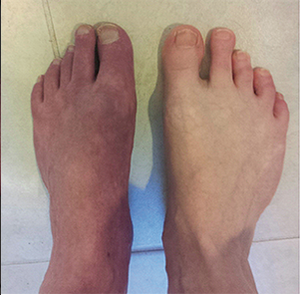
Type II CRPS showing skin changes[3]
| Pain | burning, stinging, or tearing sensation that is felt deep inside the limb, usually continuous but can be paroxysmal.[4] |
| Sensory | hyperalgesia, allodynia, or hypesthesia |
| Motor | weakness, occasional tremor, myoclonus, or dystonic postures |
| Skin | warmth, skin color changes, sweating, or edema, other skin/hair/nail changes |
Differential Diagnosis
- Cellulitis
- DVT
- Infection
- Compartment syndrome
- Peripheral Vascular Disease
- Peripheral neuropathy
- Thoracic outlet syndrome
- Rheumatoid arthritis
- Chronic inflammatory autoimmune disease
- Raynaud phenomenon
- Erythromelalgia
- Conversion disorder
- Factitious disorder
Evaluation
Clinical: Budapest consensus criteria:
At least 1 symptom in three of the following four categories:
| Sensory | allodynia, hyperalgesia |
| Vasomotor | temperature asymmetry, skin color changes, skin color asymmetry |
| Sudomotor | edema, sweating |
| Motor/trophic | decreased ROM, weakness, tremor, dystonia, trophic changes (hair, nail, skin) |
- And, there is no other diagnosis that better explains the signs and symptoms
Rule-Out Emergent Etiologies
- XR
- CBC
- Ultrasound
Other Imaging
- CT/MRI/XR are all NOT diagnostic for CRPS[4]
Management
Ketamine for Flare-Ups
- Initial bolus - 0.2–0.3 mg/kg of infused over 10mins.[3]
- Avoid IV push - could cause dissociative side effects.
- Diagnostic- pain should resolve by the end of the 10min bolus and if so, continue
- Infusion - 0.2 mg/kg/hr over 4-6hrs.
No discharge prescription usually required. If needed:
- Ibuprofen - 400-800 mg TID or naproxen 250-500 mg BID[5]
- Amitriptyline or nortriptyline - 10-25 mg at bedtime as initial dose for both[4]
- Gabapentin - 100 mg-300 mg at bed time
- Topical lidocaine cream - 2-5% or topical capsaicin cream 0.075%
Opioids should NOT be used for chronic or acute CRPS. Patient education on this is important.
Disposition
- Outpatient follow-up with pain management
- Referral for PT/OT - important for all CRPS patients
- Consider psychiatric referral if warranted
See Also
External Links
References
- ↑ Schwartzman RJ, Erwin KL, Alexander GM (May 2009). "The natural history of complex regional pain syndrome". The Clinical Journal of Pain. 25 (4): 273–80. doi:10.1097/AJP.0b013e31818ecea5. PMID 19590474.
- ↑ Sandroni P, Benrud-Larson LM, McClelland RL, Low PA. Complex regional pain syndrome type I: incidence and prevalence in Olmsted county, a population-based study. Pain 2003; 103:199.
- ↑ 3.0 3.1 Ducharme, Jim, MD. "Tips for Managing Complex Regional Pain Syndrome - ACEP Now." ACEP Now. N.p., 11 Sept. 2015.
- ↑ 4.0 4.1 4.2 Birklein F, O'Neill D, Schlereth T. Complex regional pain syndrome: An optimistic perspective. Neurology 2015; 84:89.
- ↑ Harden RN, Oaklander AL, Burton AW, et al. Complex regional pain syndrome: practical diagnostic and treatment guidelines, 4th edition. Pain Med 2013; 14:180.